
October 30, 2026 · 6 min read
GitHits update: Research, code diffs, and a browsable index
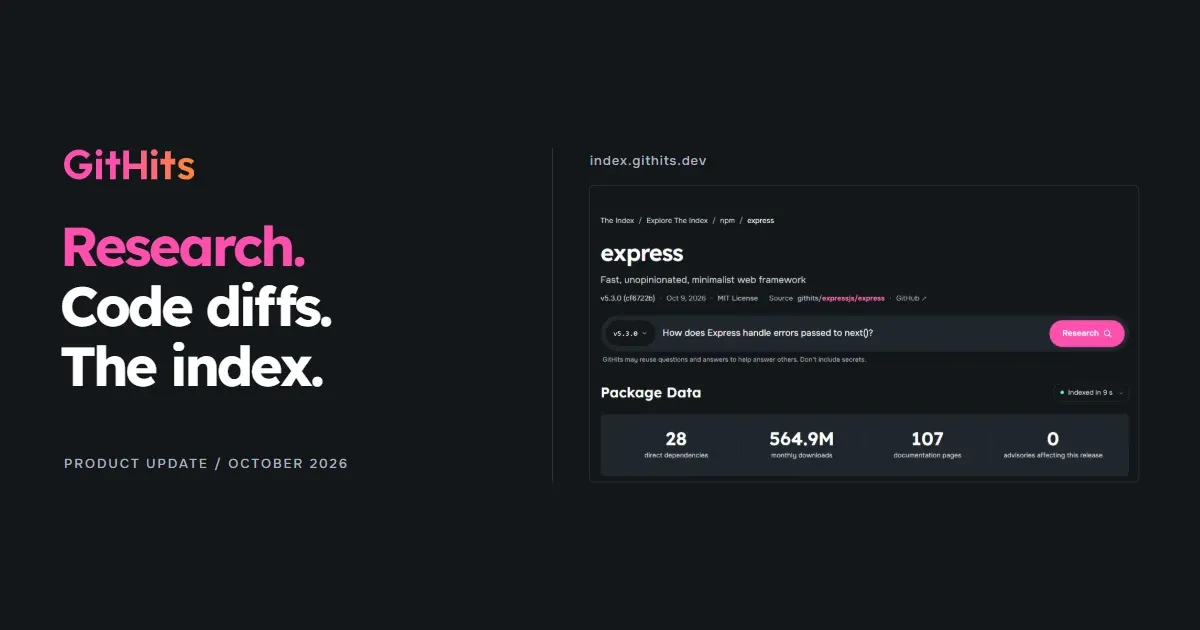
Delegate dependency research, compare source versions, and browse the GitHits index. Plus a REST API for software factories and new agent connectors.
Before changing how an application handles an error, your agent needs to understand what the dependency does with it. Before upgrading that dependency, it needs to inspect what changed between versions.
Our latest update adds three tools for that work: Research, Code diff, and Resolve target. We’ve also added a REST API for software factories, a browsable index where you can investigate packages yourself, and more ways to connect your agents.
Delegate a dependency question with Research
An agent can now hand a question about a public package or repository to GitHits using research. GitHits searches and reads the relevant code and documentation, then returns an answer with sources. The agent can ask follow-up questions in the same thread.
For example, when investigating middleware error handling:
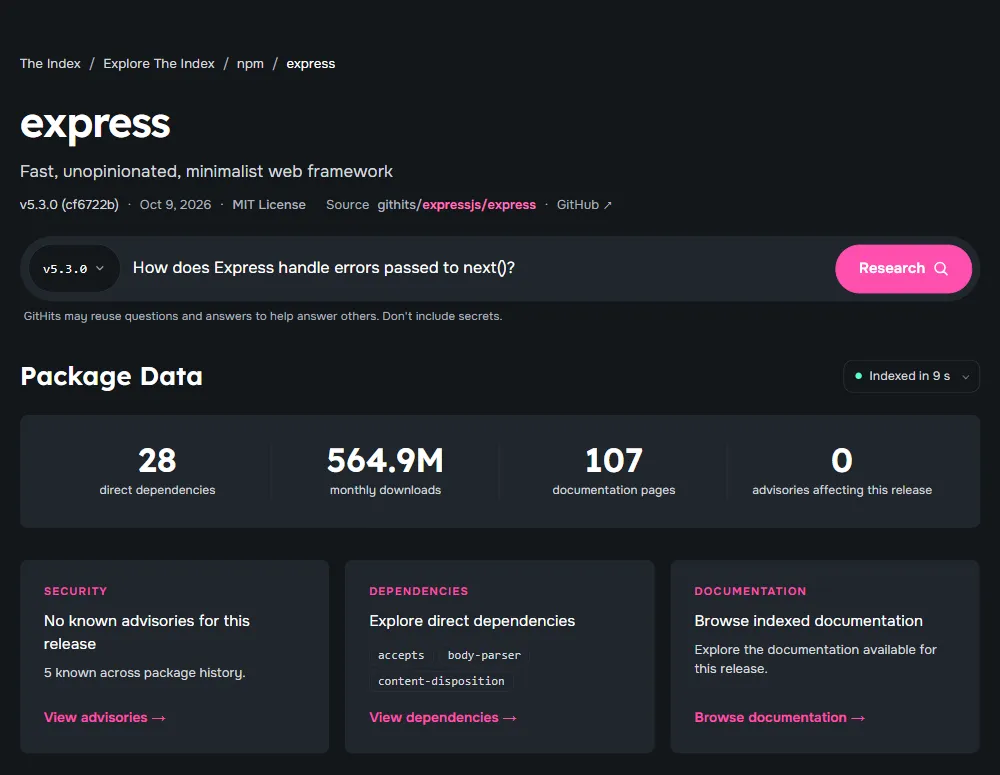
How does Express handle errors passed to
next()?
You can also ask from the CLI:
npx githits@latest research npm:express "How does Express handle errors passed to next()?"
Research handles the investigation within GitHits. Your coding agent receives the answer and the source references it can inspect further, then continues its work on the application. If the answer raises another question, it can follow up in the same thread.
The Research guide covers target selection, follow-ups, and output formats.
Compare the source behind an upgrade
Release notes describe a release. code_diff lets your agent inspect the source changes between package versions or repository refs, including changed files and patches.
That gives an upgrade review a concrete next step. If a release changes error handling, the agent can inspect the changed implementation and check the application’s callers against it. The diff shows what changed; the agent still needs to assess how those changes affect your code.
Diffs cover the underlying repository, including when the input is a package target. Our cross-repository agent example shows how an agent uses the API to compare revisions and inspect related projects. The code navigation guide documents the tool.
Find the right project before searching it
Sometimes an agent has a dependency name but needs to work out which package, repository, or documentation site to query. resolve_target returns ranked matches for that name.
A target is the specific project or site a GitHits tool will search or read, such as npm:express. The resolver helps distinguish similarly named projects before the agent continues. When a result is ambiguous, the agent can narrow the request or ask you to choose. If it already knows the target, it can use it directly.
See the target resolution guide for examples.
Browse the index and ask questions in your browser
The GitHits index now has a browsable site. Look up a package or repository, select a version or ref, and explore its indexed information. Package pages bring together dependencies, security advisories, and documentation.
You can also ask a research question directly from a package or repository page. This gives you a way to investigate a dependency without opening a coding-agent session.
A README badge for maintainers
If you maintain an open-source project, you can copy badge Markdown from its index page into your README. The badge shows the repository’s live index status and links to its GitHits page.
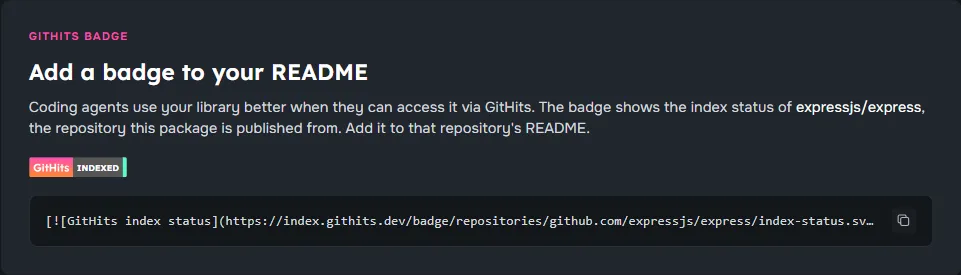
Start with your project’s index page or read the maintainer guide.
A REST API for software factories
If you’re building a software factory, its agents need access to the dependencies they discover, integrate, debug, and maintain. The new REST API gives you direct HTTP access to GitHits source, documentation, and package data so you can tailor retrieval, response handling, and orchestration to your workflow.
Our co-founder Nathan Burg has been testing what those integrations can do:
- Dependency checks. In a benchmark of 35 packages divided into four batches, the GitHits agent with Gemma 4 31B checked a batch in a median of 4.6 seconds, compared with 61.2 seconds for Codex with gpt-6.1-sol alone. Each batch was repeated five times per setup. These timings compare the tested models and workflows, rather than measuring a general speed improvement.
- Tracing errors to source. Across 110 errors from GitHub issues, Gemma 4 31B identified the correct source file and function 69.7% of the time with GitHits, up from 9.7% without it. Those results average three runs of the single-model-call workflow and measure source identification, not whether a proposed fix works.
- Version-specific API definitions. Across five models on 120 coding tasks, always providing version-specific definitions through GitHits raised correct API calls from 68% to 94%. The checks measured the targeted API calls, not whole-application correctness.
The REST API is available for evaluation; the v1 contract is not yet finalized. The documentation covers authentication, requests, responses, and integration examples.
More ways to connect your agents
GitHits is now available through the Cursor marketplace, the Claude connector directory, and Vercel Connect. Vercel Connect provides a route for using GitHits in your own apps and agents.
Our ChatGPT / Codex plugin is coming soon. You can already configure Codex through the existing CLI and MCP setup.
Other changes since August
- Shared tools for code and documentation.
grep,list, andreadnow work across both, giving agents the same operations to find and inspect source files and documentation. - Deeper dependency checks. Agents can check known vulnerabilities in a package’s dependencies and flag outdated, deprecated, duplicate, or conflicting dependencies.
- More useful upgrade reviews. Release-note changes are grouped by version, with source links and filters to focus on changes that may need action. Nathan’s changed-defaults study also shows why inspecting source in both releases matters when checking the impact on application code.
- More repository hosts. GitHits supports public projects on GitLab, Codeberg, and Launchpad alongside GitHub.
- A renewed website. The website now includes tool examples and dedicated pages for software factories, developers, and maintainers.
The changelog has the full release history.
Try the update
If you use the local setup, rerun the installer to refresh your GitHits configuration and agent guidance:
npx githits@latest init
Then ask your agent a question about a dependency you’re working with, or open the index and try Research from its package page.
If something doesn’t work as expected, open an issue.