
October 22, 2026 · 11 min read
Checking dependency upgrades for changed defaults
A library upgrade can change your application without changing its code. We tested agents that compare default settings in the old and new releases.
Upgrading a library can change what your application does even when your own code stays the same. Suppose a network request uses the library’s default timeout because you never set one. If a new release changes that default, the request may start failing sooner or waiting longer.
A dependency bump is a change to the library version your project uses. Reviewing one often means checking a small change in a dependency file. The setting that affects your application may be several layers away, inside the library.
We built an agent to look for these changes. It reads the old and new releases, then checks which calls in the application rely on a default that changed. GitHits provides access to both versions without installing them in the agent’s environment.
We tested six models on 81 real upgrade pull requests. All six found more of the changed defaults when they could read both releases through GitHits. The sections below explain what we asked them to find, how we scored their answers, and where they still missed changes.
The task
Consider a pull request (PR) upgrading the Python redis package from 5.x to 8.0. The application calls into the package without setting connection options such as socket_timeout or ssl_check_hostname. Those calls rely on the library to supply the values.
We give the agent the application’s call sites: the places where its code calls a function or creates an object from the package. Each includes the file, line, call, and imports. The agent must identify each call that omits a parameter whose declared default changed between releases.
A finding therefore has two parts: the affected call site and the parameter it leaves unset. We excluded added, removed, and renamed parameters to keep the experiment focused on changed defaults. A changed declaration can deserve review even when it has no practical effect in a particular application.
What the agent is allowed to read
We kept the prompt, agent workflow, and self-check the same while changing the available information:
- Memory only: the model answers without tools, using what it learned during training.
- Installed version: the agent can search and read the old release installed in Python’s
site-packagesdirectory. A helper also shows function parameters and defaults. This represents an environment where the proposed release hasn’t been installed yet. - GitHits, both releases: the agent uses equivalent tools through the API to inspect the old and new releases, such as
pypi:redis@5.0.1andpypi:redis@8.0.0.
The self-check asks the model to reconsider an answer when it lists an unknown call site, flags a parameter the application explicitly sets, or reports identical old and new defaults. It uses the supplied calls and the agent’s answer. It has no access to the answer key.
How we built the benchmark
We used 81 Dependabot upgrade PRs from 81 public repositories, covering 29 packages from PyPI, the Python package registry. Dependabot opens PRs to update dependencies. For each project, we read the last commit before its upgrade PR opened and confirmed the installed version.
The dataset contained 914 call sites, about 11 per PR. We found 150 call-site and parameter pairs that relied on a changed default. In 24 of the 81 upgrades, none of the supplied calls relied on a changed default. Those cases test whether an agent raises false alarms. Thirty-eight upgrades changed the package’s major version.
We built the answer key by downloading both releases from PyPI and examining their code with Python’s ast parser. It reads the structure of Python code without running it. We extracted function parameters and defaults, resolved named constants and simple arithmetic, and followed imports and aliases to connect each application call to the library function.
This matters when two expressions look different but have the same value. A renamed constant shouldn’t count as a changed default. A change from 2**16 to 2**18 should. We counted a finding when the default value changed and the application supplied no value for that parameter, either by name or by position.
What we found
We report precision and recall as percentages, and F1 on a 0–100 scale:
- Precision: of the changes the agent flagged, how many were real?
- Recall: of the changes in the answer key, how many did it find?
- F1: a combined score that rewards both precision and recall. We show it on a 0–100 scale; 100 means every required finding and no false alarms.
“Upgrades fully right” means the entire answer for a PR matched the answer key. Model cost is per 1,000 reviews and excludes GitHits API fees. Some setups were repeated three times and others once; the limits section explains which.
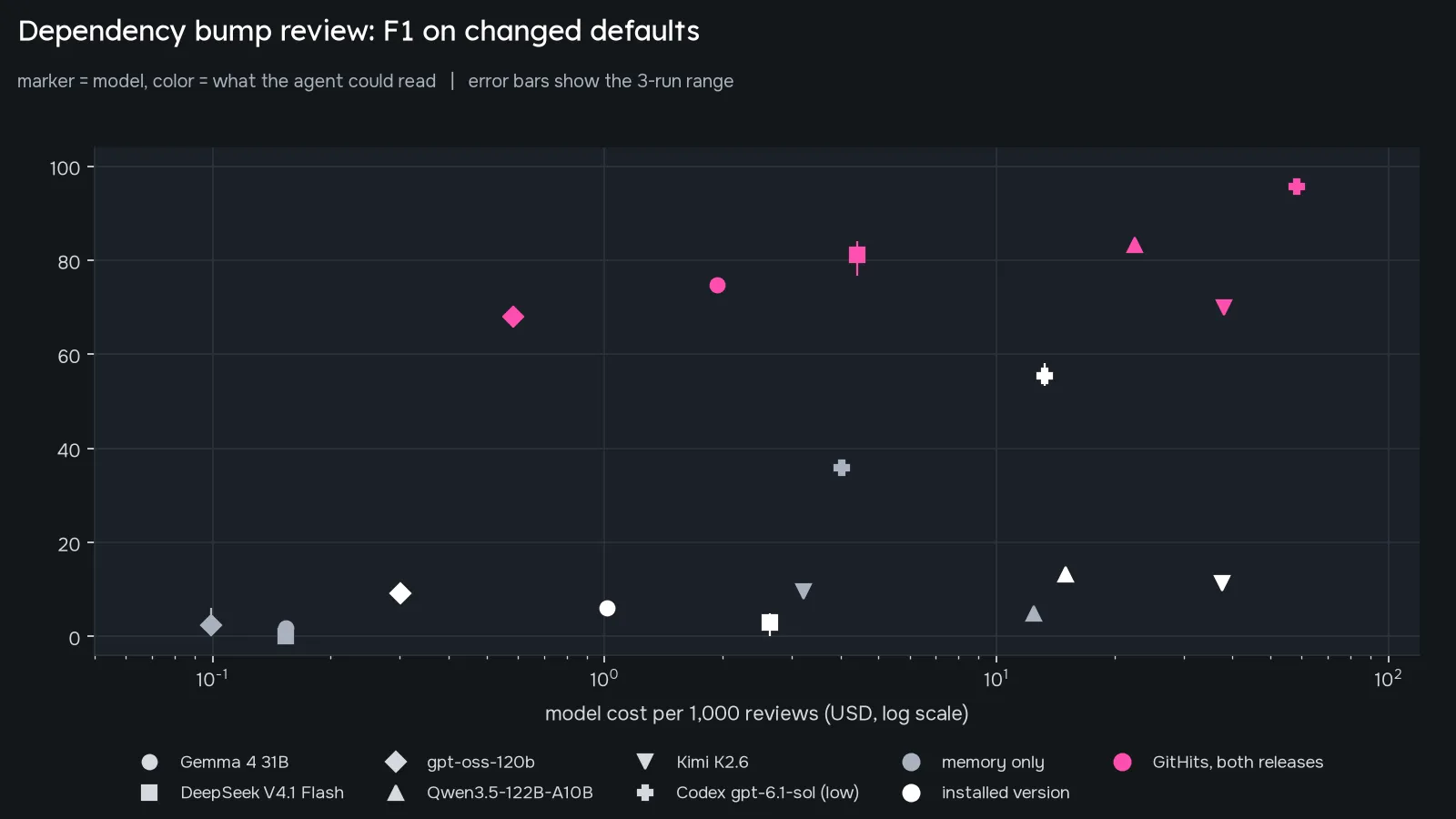
| Model | What it could read | Precision | Recall | F1 | Upgrades fully right | Model cost / 1,000 |
|---|---|---|---|---|---|---|
| Gemma 4 31B | Memory only | 100.0 | 0.9 | 1.8 | 31% | $0.15 |
| Gemma 4 31B | Installed version | 87.5 | 3.1 | 6.0 | 35% | $1.01 |
| Gemma 4 31B | GitHits, both releases | 87.0 | 65.6 | 74.8 | 68% | $1.94 |
| DeepSeek V4.1 Flash | Memory only | 0.0 | 0.0 | 0.0 | 30% | $0.15 |
| DeepSeek V4.1 Flash | Installed version | 29.2 | 1.6 | 3.0 | 31% | $2.64 |
| DeepSeek V4.1 Flash | GitHits, both releases | 90.4 | 73.6 | 81.1 | 74% | $4.42 |
| gpt-oss-120b | Memory only | 9.7 | 1.3 | 2.3 | 26% | $0.10 |
| gpt-oss-120b | Installed version | 15.4 | 6.4 | 9.1 | 28% | $0.30 |
| gpt-oss-120b | GitHits, both releases | 84.2 | 56.9 | 67.9 | 58% | $0.58 |
| Qwen3.5-122B | Memory only | 26.7 | 2.7 | 4.8 | 33% | $12.42 |
| Qwen3.5-122B | Installed version | 19.5 | 10.0 | 13.2 | 33% | $14.97 |
| Qwen3.5-122B | GitHits, both releases | 80.6 | 86.0 | 83.2 | 75% | $22.53 |
| Kimi K2.6 | Memory only | 9.6 | 9.3 | 9.5 | 25% | $3.21 |
| Kimi K2.6 | Installed version | 9.3 | 14.0 | 11.2 | 21% | $37.54 |
| Kimi K2.6 | GitHits, both releases | 60.5 | 82.7 | 69.9 | 67% | $38.00 |
| Codex gpt-6.1-sol (low) | Memory only | 79.4 | 23.1 | 35.8 | 46% | $4.03 |
| Codex gpt-6.1-sol (low) | Installed version | 86.0 | 40.9 | 55.4 | 56% | $13.27 |
| Codex gpt-6.1-sol (low) | GitHits, both releases | 93.4 | 98.0 | 95.7 | 91% | $58.43 |
Every model scored higher with access to both releases. Reading the installed version showed what the application had been using, but left the proposed defaults unavailable. With GitHits, F1 scores ranged from 67.9 to 95.7. With the installed version alone, they ranged from 3.0 to 55.4.
DeepSeek V4.1 Flash with GitHits reached 81.1 F1 at $4.42 in model cost per 1,000 reviews. Codex with GitHits reached 95.7 F1 at an estimated $58.43. Codex gave a fully correct answer on 91% of upgrades and raised no false alarms on the 24 upgrades with no relevant default changes. These results show the cost and accuracy choices within this experiment.
Most models with GitHits had precision between 81% and 93%; Kimi reached 61%. Missed changes were a larger problem for several models. Sometimes they skipped a called function or decided a changed default didn’t matter. Typer’s pretty_exceptions_show_locals was the most frequently missed setting.
The self-check improved F1 in the GitHits setup from 52 to 68 for gpt-oss-120b, 69 to 75 for Gemma, and 60 to 70 for Kimi.
What the agent caught
These examples show the kinds of defaults the agent compared. The linked releases contain the old and new declarations:
- xgboost changed the setting for categorical data, such as named groups. In
DMatrix,enable_categoricalwent fromFalsetoTrue(old release, new release). F1 across all models on xgboost went from 2 with the installed version to 99 with GitHits. - aiohttp changed how much data its HTTP client buffers while reading a response.
ClientSessionraisedread_bufsizefrom 64 KiB to 256 KiB (old release, new release). F1 across all models on aiohttp went from 1 with the installed version to 88 with GitHits. - scipy changed a setting used in signal analysis. Its
welchandstftfunctions changedwindowfrom'hann'to'hann_periodic'(old release, new release). F1 across all models on scipy went from 34 with the installed version to 94 with GitHits. - werkzeug changed its default password-hashing method.
generate_password_hashmovedmethodfrom pbkdf2 to scrypt (old release, new release). F1 across all models on werkzeug went from 64 with the installed version to 99 with GitHits.
Typer and redis had the lowest scores with GitHits. In Typer, the changed setting controls whether error reports show local variables. In redis, several connection settings changed at once, including timeouts and hostname checking.
The table combines results across models for packages with relevant changes. “Changed defaults in calls” counts the call-site and parameter pairs the agent needed to flag.
| Package | Upgrade PRs | Changed defaults in calls | F1 (installed) | F1 (GitHits) |
|---|---|---|---|---|
| aiohttp | 6 | 20 | 0.6 | 88.1 |
| fastapi | 3 | 2 | 36.8 | 84.0 |
| langchain-core | 1 | 1 | 42.1 | 92.9 |
| matplotlib | 2 | 1 | 0.0 | 80.0 |
| pandas | 4 | 6 | 26.9 | 68.5 |
| polars | 7 | 15 | 27.6 | 76.2 |
| python-telegram-bot | 1 | 3 | 31.0 | 53.6 |
| redis | 7 | 21 | 20.8 | 51.2 |
| scikit-learn | 7 | 10 | 23.6 | 72.3 |
| scipy | 3 | 12 | 33.6 | 93.5 |
| tenacity | 7 | 6 | 4.2 | 75.1 |
| typer | 4 | 11 | 18.9 | 42.0 |
| werkzeug | 7 | 6 | 64.2 | 98.8 |
| xgboost | 7 | 36 | 2.2 | 98.7 |
Limits of the comparison
Codex ran through a ChatGPT subscription using codex exec. Its model costs are list-price estimates based on recorded transcript sizes. The other models’ costs are the amounts charged by OpenRouter.
Gemma, DeepSeek, gpt-oss, and Codex each ran three times. Qwen and Kimi ran once to stay within budget, so we can’t report their variation between runs. Eleven of the 3,402 runs exceeded the time limit and were scored as no answer.
We measured changes in declared defaults. Some have no effect for a particular configuration. For example, scikit-learn changing l1_ratio from None to 0.0 under an L2 penalty leaves the calculation unchanged. A finding is a reason to inspect the affected call, rather than proof that the application will behave differently.
The experiment covered Python, and the agent received the call sites in advance. It didn’t have to discover them. A complete review workflow would also need a way to collect those calls, such as a static analyzer that examines code without running it.
Running this yourself
For a similar review workflow, the experiment suggests testing a lower-cost model with access to both releases. DeepSeek with GitHits provided one useful balance of cost and accuracy; Codex with GitHits found more changes at a higher model cost. Your own dependencies and tolerance for missed findings should guide the choice.
The agent uses /v1/grep to find a function or class in a specific release, then /v1/read to read its source. It repeats those API calls for the old and new versions. The REST API is open for evaluation at https://api.githits.dev/v1; the v1 contract isn’t final yet.
- Get a key: create a token in your GitHits account and send it as
Authorization: Bearer. The authentication guide covers CI and runtime storage. - First call: the API quickstart walks through one request.
- Reference: the API overview links the full v1 reference, where you can try requests with your token.
If you want to add this check to an automated review workflow, book a call to discuss the integration.
